

BPH Surgery in Mumbai: Modern Treatment Options for Enlarged Prostate


Benign Prostatic Hyperplasia (BPH), commonly known as an enlarged prostate, is a non-cancerous condition that becomes increasingly common with age. As the prostate enlarges, it can press against the urethra and make it difficult for the bladder to pass urine efficiently. Symptoms such as a weak urinary stream, frequent urination, urgency, interrupted urine flow and waking several times at night can gradually affect sleep, work, travel and overall quality of life.
For men whose symptoms continue despite medication or who develop complications from urinary obstruction, modern surgical treatments can provide durable relief. At Jewel Urology Center, Dr. Vivek Venkat offers individualized evaluation and advanced treatment options for men requiring BPH Surgery in Mumbai, including TURP, laser prostate procedures and robotic simple prostatectomy.
What Is BPH?
The prostate is a gland located below the urinary bladder and surrounding the urethra. With age, hormonal changes can cause the prostate to enlarge. Although BPH is not prostate cancer, an enlarged prostate can narrow the urinary passage and make normal urination increasingly difficult.
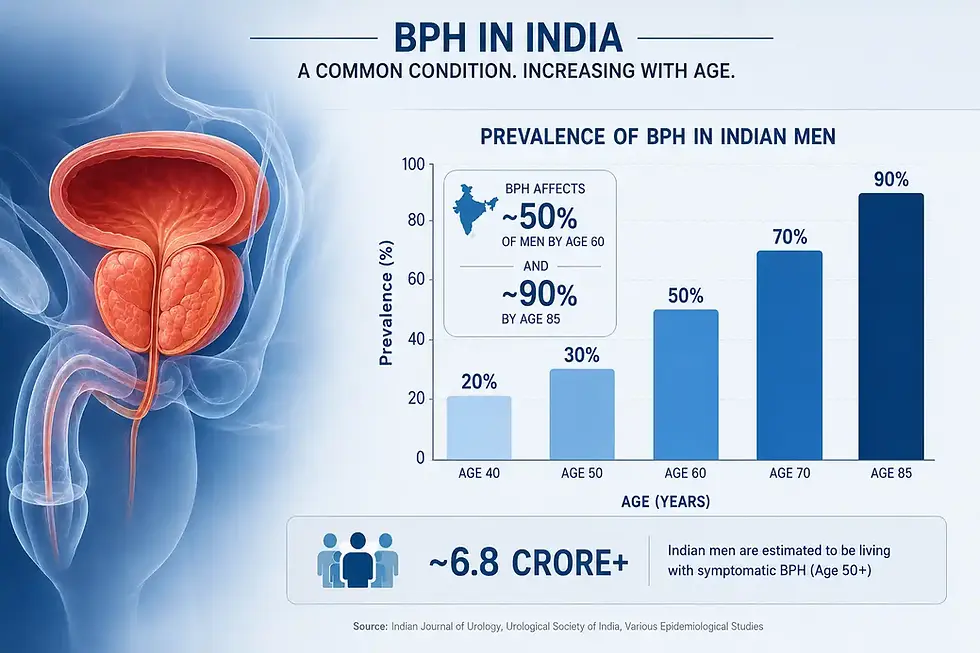
The condition is particularly common among older men. According to the information provided on Dr. Venkat’s treatment page, approximately half of men develop prostate enlargement by age 60, while the majority are affected by age 85.
Common symptoms include:
Weak or slow urine flow
Difficulty starting urination
Straining while urinating
Interrupted urine stream
Dribbling after urination
Frequent urination
Urinary urgency
Getting up repeatedly at night
Feeling that the bladder has not completely emptied
Persistent obstruction may also contribute to urinary infections, bladder stones, blood in the urine, acute urinary retention and, in severe cases, problems affecting kidney function.
How Is an Enlarged Prostate Diagnosed?
A proper evaluation is important before deciding whether medication, monitoring or surgery is appropriate. Dr. Venkat’s BPH evaluation may involve several assessments depending on the patient’s symptoms and medical history.
These can include:
IPSS or AUA symptom scoring
Prostate examination
Urine testing
Uroflowmetry to assess urinary flow
PSA blood testing
Ultrasound to assess prostate size and residual urine
Assessment of bladder and kidney health
The objective is not simply to measure prostate size but to understand how the enlargement is affecting urinary function and the patient’s quality of life.
When Is BPH Surgery Recommended?
Not every man with an enlarged prostate needs surgery. Medication and lifestyle measures may be appropriate when symptoms are manageable. However, surgery can be considered when symptoms remain troublesome despite medication or when complications develop.
Reasons for considering surgery may include:
Persistent urinary symptoms despite appropriate medication
Repeated episodes of acute urinary retention
Chronic urinary retention
Kidney problems caused by obstruction
Recurrent urinary infections
Bladder stones
Repeated bleeding in the urine
Significant deterioration in quality of life
Patients who prefer a definitive procedural solution rather than long-term medication may also discuss surgical options with their urologist.
Modern Surgical Options for BPH
TURP
Transurethral Resection of the Prostate, or TURP, is an established treatment for relieving obstruction caused by an enlarged prostate. The procedure is performed through the urinary passage using an endoscope, so there is no external surgical incision.
During TURP, obstructing prostate tissue is removed to improve urine flow and bladder emptying. Bipolar TURP can also be used for appropriately selected larger prostates.
Laser Prostate Surgery
Laser procedures such as HoLEP and ThuLEP are minimally invasive options that can be particularly useful for larger prostates and for selected patients with increased bleeding concerns.
Potential benefits include less blood loss, shorter catheter duration, faster recovery and reduced hospital stay. The most appropriate laser technique depends on prostate anatomy, size, medications and overall health.
Robotic Simple Prostatectomy
For very large prostates, robotic simple prostatectomy may be considered. Unlike robotic surgery performed for prostate cancer, this procedure focuses on removing the enlarged obstructing portion of the prostate while leaving the remaining prostate tissue.
The robotic approach provides magnified three-dimensional visualization and can offer benefits such as smaller incisions, reduced blood loss and potentially faster recovery in appropriately selected patients.
How Is the Right Procedure Selected?
There is no single procedure that is ideal for every patient. Treatment selection depends on prostate size, urinary symptoms, bladder function, medical conditions, medications and individual expectations. Smaller or moderately enlarged prostates may be treated with TURP or laser procedures, while very large glands may be candidates for robotic simple prostatectomy.
A personalized consultation allows the urologist to assess the complete clinical picture before recommending a treatment.
Why Choose Dr. Vivek Venkat for BPH Treatment?
Dr. Vivek Venkat is a Consultant Uro-Oncologist and Robotic Urologist with more than 15 years of professional experience. He completed his MBBS at B.J. Medical College, Pune, M.S. in General Surgery at Seth G.S. Medical College and K.E.M. Hospital, Mumbai, and M.Ch. in Urology at Christian Medical College, Vellore, where he was a Gold Medalist.
He completed advanced fellowship training in Uro-Oncology and Robotic Surgery at the University of Miami Miller School of Medicine, USA, and served as a Clinical Instructor in Urologic Oncology and Robotic Surgery at the University of Miami Hospital. His professional background also includes experience as an Assistant Professor of Urology and Renal Transplantation at CMC Vellore.
His expertise includes minimally invasive urology, robotic surgery, prostate conditions, kidney and bladder disorders and complex urological procedures. His profile also highlights experience in more than 800 robotic procedures during his advanced training and clinical career.
For patients searching for a Best Uro Surgeon in Mumbai, Dr. Venkat combines advanced international training with a patient-first approach. His practice emphasizes personalized consultation, evidence-based treatment, minimally invasive techniques and appropriate post-surgical follow-up.
The clinic environment is designed around personalized attention and comprehensive urological care. Dr. Venkat practices at Jewel Urology Center in Vile Parle West, with additional practice locations in Mumbai, and offers consultation and follow-up care based on individual patient needs.
His broader robotic expertise also includes procedures such as Robotic Adrenalectomy Surgery in Mumbai, reflecting his experience with advanced minimally invasive urological surgery.
Recovery After Prostate Surgery
Recovery varies according to the procedure performed, prostate size and the patient’s overall health. A temporary urinary catheter is commonly used after surgery, while the duration of hospitalization depends on the surgical technique and individual recovery.
Patients are generally advised to stay hydrated, avoid strenuous exercise and heavy lifting, prevent constipation and attend scheduled follow-up appointments. Temporary urinary burning, urgency or frequency can occur after catheter removal and generally improves as healing progresses.
Most appropriately selected patients experience improved urinary flow, better bladder emptying, fewer nighttime trips to the bathroom and meaningful improvement in quality of life following treatment.
Schedule a Consultation with Dr. Vivek Venkat
If urinary symptoms are affecting your sleep, daily routine or quality of life, an early urological assessment can help determine whether medication, monitoring or surgery is appropriate.
Frequently Asked Questions
1. Is BPH surgery painful?
Modern prostate procedures are generally associated with limited pain. Catheter-related discomfort may be one of the more noticeable short-term issues. Your surgeon will provide appropriate pain management and recovery instructions.
2. How long does a catheter stay after prostate surgery?
Many patients require a catheter for around two to three days, although patients undergoing more extensive procedures or treatment for very large prostates may need it for longer. The exact duration depends on recovery and the procedure performed.
3. Which is better: TURP, laser surgery or robotic surgery?
The best option depends on prostate size, symptoms, bladder function, medical conditions and treatment goals. TURP may be suitable for routine cases, laser procedures can be useful for larger glands, and robotic simple prostatectomy may be considered for very large prostates. A urological evaluation is necessary before choosing a procedure.
4. Can BPH return after surgery?
BPH surgery can provide durable relief by removing the obstructing prostate tissue. However, continued prostate health monitoring remains important because prostate tissue can change over time.


Comments