

Enlarged Prostate Treatment in Mumbai: Symptoms, Diagnosis and Medical Management

Benign Prostatic Hyperplasia (BPH), commonly called an enlarged prostate, is one of the most frequent urological conditions affecting aging men. Although BPH is not cancer, enlargement of the prostate can gradually narrow the urinary passage and make it harder for the bladder to empty normally. Symptoms may begin mildly but can eventually interfere with sleep, travel, work, social activities and overall quality of life.
The good news is that an enlarged prostate does not always require surgery. Depending on symptom severity, prostate size, bladder function and overall health, many men can achieve effective long-term relief with medicines and regular monitoring. Enlarged Prostate Treatment in Mumbai should therefore begin with an individualized urological evaluation rather than assuming that surgery is immediately necessary.
What Is an Enlarged Prostate?
The prostate is a walnut-sized gland situated below the urinary bladder and surrounding part of the urethra. As men age, hormonal changes can cause the prostate to gradually enlarge. This enlargement can increase resistance to urine flow and produce lower urinary tract symptoms.
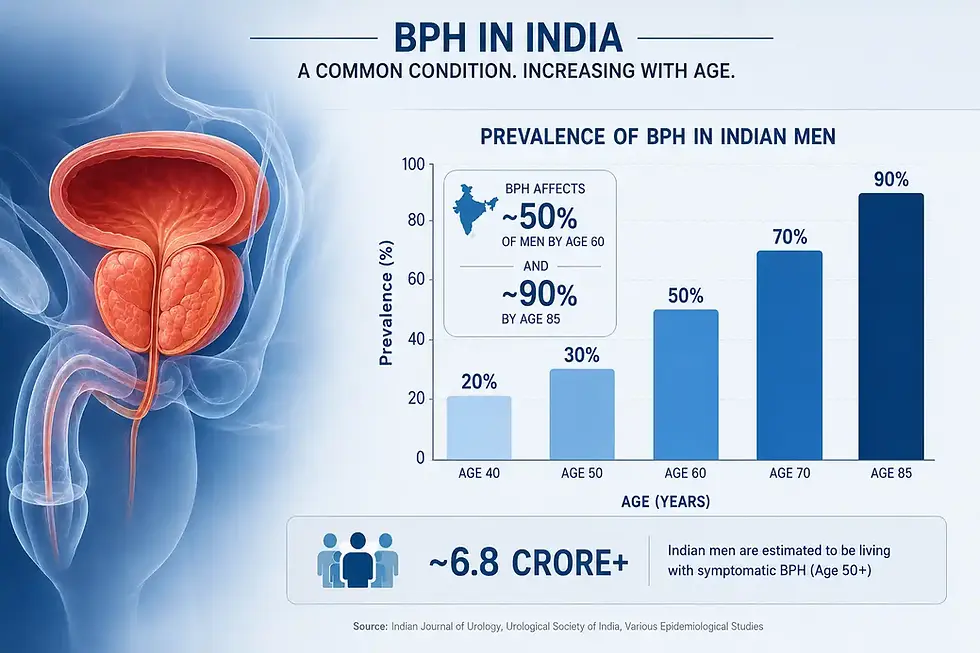
BPH commonly develops after the age of 40–50. The condition becomes increasingly common with age, with the official treatment page noting that approximately 50% of men have some prostate enlargement by age 60 and nearly 90% by age 85.
Risk factors may include:
Increasing age
Family history
Diabetes
Obesity
Metabolic syndrome
Sedentary lifestyle
Recognizing these factors can help men seek timely assessment instead of considering urinary changes simply a normal part of aging.
Common Symptoms of an Enlarged Prostate
BPH symptoms can involve problems with both passing and storing urine.
Problems With Urine Flow
Men may experience:
Weak or reduced urinary stream
Difficulty starting urination
Straining while passing urine
Interrupted urine flow
Dribbling after urination
Taking longer to empty the bladder
A persistent feeling of incomplete bladder emptying
Bladder Storage Symptoms
Other symptoms can include:
Frequent urination
Sudden urinary urgency
Waking repeatedly at night to urinate
Difficulty controlling urine
Occasional leakage before reaching the bathroom
When these symptoms persist or worsen, consultation with a urologist can help determine their cause and severity.
Can an Enlarged Prostate Cause Complications?
While BPH itself is a benign condition, untreated urinary obstruction can sometimes lead to complications.
Acute urinary retention, in which a man is suddenly unable to pass urine, can be painful and requires urgent medical attention. Chronic retention may leave significant urine in the bladder and, in severe cases, affect kidney drainage and function.
Other possible complications include recurrent urinary tract infections, bladder stones and blood in the urine. For this reason, persistent urinary symptoms should not be ignored.
How Is BPH Diagnosed?
An accurate diagnosis helps determine whether observation, medication or a procedural treatment is appropriate. Dr. Vivek Venkat’s approach involves assessing both symptoms and objective measures of urinary function.
A urological assessment may include:
IPSS/AUA symptom score:A standardized questionnaire helps determine the severity of urinary symptoms and monitor changes during treatment.
Prostate examination:A clinical examination may help assess prostate size and identify abnormalities requiring further evaluation.
Urine analysis:Urine testing can identify infection, blood or other urinary abnormalities.
Uroflowmetry:This test measures the speed and pattern of urine flow and can help assess obstruction.
PSA testing:A PSA blood test may be recommended as part of prostate health assessment and prostate cancer risk evaluation.
Ultrasound:Ultrasound can assess prostate size, bladder condition, residual urine after urination and, when relevant, the kidneys and urinary tract.
When Is Medical Treatment Appropriate?
Not every man with BPH needs an operation. Men with mild to moderate symptoms and without significant complications may be suitable for medical management.
Medication may be considered for symptoms such as:
Weak urinary flow
Frequent urination
Nighttime urination
Urgency
Incomplete bladder emptying
Gradually worsening urinary symptoms
The objective is to improve urinary function, protect bladder health and reduce the risk of progression or complications.
Medicines Used for BPH
Different medicines work in different ways, so treatment should be individualized by a qualified urologist.
Alpha Blockers
Medicines such as tamsulosin, alfuzosin and silodosin relax muscles around the prostate and bladder neck. This can reduce resistance to urine flow and improve symptoms.
5-Alpha Reductase Inhibitors
Finasteride and dutasteride work differently. They target hormonal mechanisms involved in prostate growth and can gradually reduce prostate size. These medicines may take several months to achieve their full effect and are sometimes combined with alpha blockers.
Other Medicines
Depending on a patient’s symptoms, a urologist may also consider medicines such as tadalafil, selected anticholinergic medicines or beta-3 agonists for particular bladder storage symptoms.
Patients should not start, stop or change prostate medication without discussing it with their doctor.
Can Medicines Prevent BPH From Getting Worse?
Medical management can provide more than temporary symptom relief for appropriately selected patients. Certain medicines can reduce prostate growth, decrease the risk of urinary retention and lower the likelihood of future complications.
Regular follow-up remains important because symptoms, urinary flow, bladder function, prostate growth and medication tolerance can change over time. Monitoring allows treatment to be adjusted when necessary.
Lifestyle Changes That Can Support Treatment
Lifestyle adjustments can complement medical treatment. Depending on individual circumstances, men with BPH may benefit from:
Reducing fluids close to bedtime
Limiting excessive caffeine
Reducing alcohol intake
Maintaining a healthy weight
Staying physically active
Avoiding unnecessary delay in urination
Managing constipation
These measures may help reduce bladder irritation and improve control of urinary symptoms.
When Are Procedures or Surgery Considered?
Medication does not work equally well for everyone. Some men continue to experience significant symptoms despite appropriate treatment. Others may develop complications such as repeated urinary retention, recurrent infections, bladder stones, progressive bladder dysfunction or declining kidney function.
In such cases, a urologist may recommend additional evaluation and discuss minimally invasive or surgical options. Dr. Venkat’s expertise includes TURP, laser prostatectomy and robotic simple prostatectomy for appropriate patients.
The choice depends on prostate anatomy, symptom severity, bladder function, overall health and individual treatment goals.
Why Choose Dr. Vivek Venkat for BPH Care?
Dr. Vivek Venkat is a Consultant Uro-Oncologist and Robotic Urologist with advanced international training. He completed his MBBS at B.J. Medical College, Pune, M.S. in General Surgery at Seth G.S. Medical College and K.E.M. Hospital, Mumbai, and M.Ch. in Urology at Christian Medical College, Vellore, where he was a Gold Medalist.
He completed a fellowship in Uro-Oncology and Robotic Surgery at the University of Miami Miller School of Medicine in the USA and served as a Clinical Instructor in Urologic Oncology and Robotic Surgery at the University of Miami Hospital. He has also served as an Assistant Professor of Urology and Renal Transplantation at CMC Vellore.
His expertise covers benign prostate conditions, prostate cancer, kidney and bladder disorders, minimally invasive urology, robotic surgery and complex urological procedures. His profile states that he participated in more than 800 robotic cases during his fellowship and maintains academic and professional ties with the University of Miami.
For patients looking for a Best Uro Surgeon in Mumbai, Dr. Venkat offers evidence-based evaluation and individualized treatment planning. His practice focuses on precision, safety and appropriate minimally invasive approaches when clinically suitable.
His broader expertise also includes advanced robotic procedures such as Robotic Adrenalectomy Surgery in Mumbai, reflecting his experience across minimally invasive urology and robotic surgery.
A Patient-Centered Approach to Prostate Care
At Jewel Urology Center, patients can discuss urinary symptoms, diagnostic findings and treatment options in a specialist-led consultation. The goal is to identify the underlying cause of symptoms and select treatment based on the patient’s individual condition rather than prostate size alone.
Early assessment can be particularly valuable for men experiencing persistent urinary symptoms, nighttime urination or a progressively weaker urine stream.
Schedule a Consultation With Dr. Vivek Venkat
If urinary symptoms are affecting your sleep, daily routine or quality of life, timely evaluation can help identify the cause and prevent avoidable complications.
Book an appointment with Dr. Vivek Venkat at Jewel Urology Center for a comprehensive assessment of urinary symptoms and a personalized BPH treatment plan.
Frequently Asked Questions
1. Does an enlarged prostate mean prostate cancer?
No. BPH is a benign enlargement of the prostate and is different from prostate cancer. However, appropriate prostate evaluation may still be recommended to assess overall prostate health and determine whether additional testing is needed.
2. Can an enlarged prostate be treated without surgery?
Yes. Many men with mild to moderate BPH symptoms can be successfully managed with medication, lifestyle changes and regular monitoring. Surgery or a procedure may be considered if symptoms remain troublesome or complications develop.
3. How long can BPH medicines be taken?
Many commonly prescribed BPH medicines can be used for extended periods under medical supervision. Regular follow-up helps the urologist assess effectiveness, side effects and whether the treatment remains appropriate.
4. What if symptoms continue despite medication?
If symptoms remain significant despite appropriate medical treatment, further evaluation may be required. Depending on the findings, a urologist may discuss minimally invasive procedures or surgery.


Comments